Melanotan II
Also known as: MT-II
A synthetic peptide that activates multiple hormone receptors at once. It produces skin tanning, increased sexual arousal, and reduced appetite simultaneously because it affects several receptor types. One of the most widely used peptides globally, primarily for cosmetic tanning and sexual enhancement, despite significant safety concerns.
Melanotan II is a synthetic analog of alpha-melanocyte-stimulating hormone (α-MSH) that activates melanocortin receptors throughout the body. Originally developed at the University of Arizona as a potential sunless tanning agent, it has become one of the most widely used cosmetic peptides worldwide — though it remains unapproved by any regulatory agency and carries significant safety concerns.
Melanotan II's tanning effect works by stimulating MC1 receptors on melanocytes in the skin, increasing production of eumelanin (the brown/black pigment that provides UV protection). Unlike topical self-tanners that stain the outer skin layer, Melanotan II produces genuine melanin-based pigmentation from within. However, because it is a non-selective melanocortin agonist, it also activates MC3 and MC4 receptors, producing additional effects including appetite suppression, increased libido, and spontaneous erections.
The safety profile of Melanotan II is concerning. It darkens moles and freckles unpredictably, which can mask warning signs of melanoma. Nausea is common and often severe during initial dosing (affecting over 50% of users). There are theoretical concerns about promoting skin cancer by increasing melanogenesis in UV-exposed skin. Dermatological monitoring is strongly recommended for anyone using this peptide.
Dosage
0.25-0.5 mg subcutaneous daily (loading) then 0.5 mg 1-2x weekly
Dosages shown are for research reference only. Always consult a qualified healthcare provider.
Administration
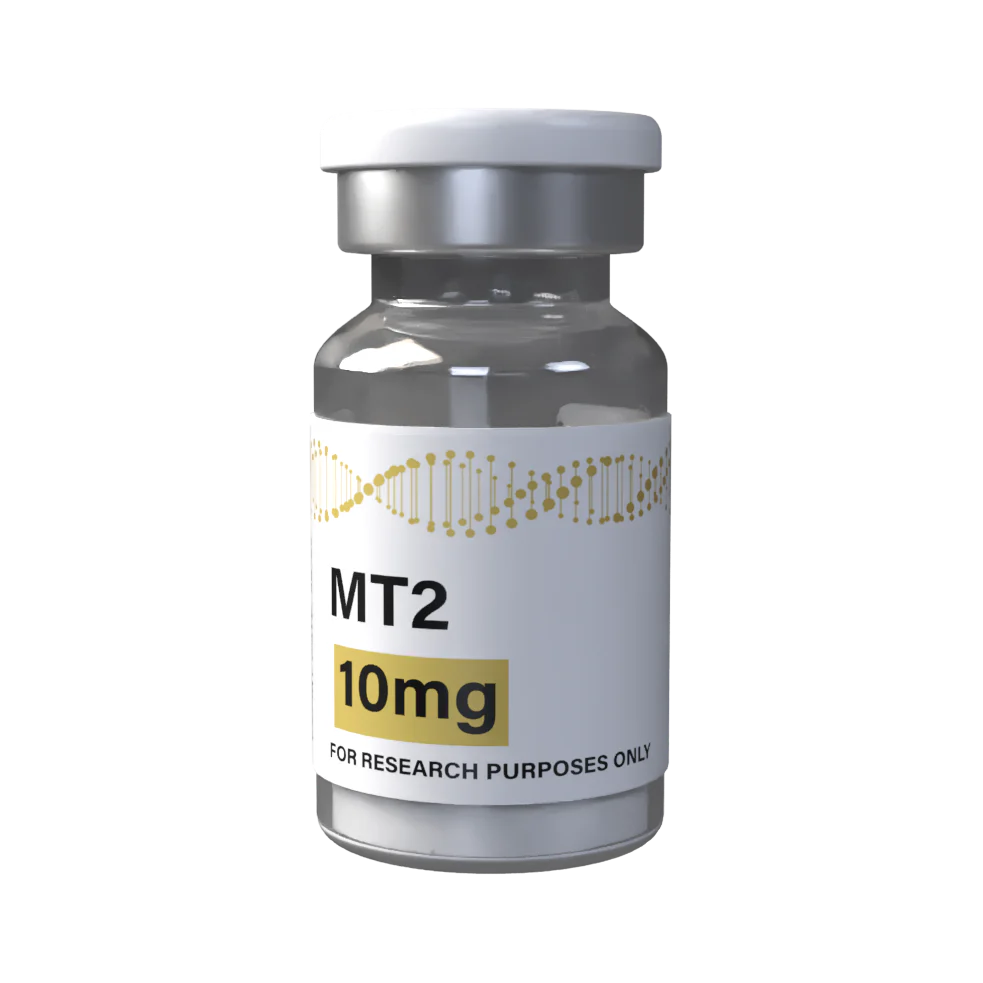
Get Research-Grade Melanotan II
99%+ purity · US-based · third-party lab tested
Getting Started — Here's What You'll Need
Effects
Skin Tanning
Non-selective melanocortin activation produces rapid skin darkening.
Sexual Arousal
MC3R/MC4R activation in the hypothalamus produces notable libido increase.
Appetite Suppression
MC4R activation reduces food intake through hypothalamic signaling.
Mechanism of Action
Melanotan II is a synthetic cyclic heptapeptide analogue of α-MSH with a fundamentally different receptor profile from the linear Melanotan I. Its cyclic structure (achieved through a lactam bridge between aspartic acid and lysine residues) provides metabolic stability and, critically, non-selective binding to multiple melanocortin receptors (MC1R through MC5R), producing a diverse range of physiological effects.
MC1R activation on melanocytes drives the same eumelanin production pathway as MT-I: cAMP → PKA → CREB → MITF → tyrosinase/TRP-1/TRP-2, resulting in skin darkening independent of UV exposure. However, MT-II's additional activation of MC3R and MC4R in the hypothalamus produces effects that MT-I does not. MC4R is a key regulator of sexual function and energy balance — its activation in the paraventricular nucleus stimulates sexual arousal and erectile function through descending autonomic pathways, while simultaneously suppressing appetite through inhibition of orexigenic NPY/AgRP neurons. This is why MT-II produces the notable combination of tanning, increased libido, and reduced appetite.
MC3R activation contributes to energy homeostasis regulation and may modulate natriuresis (sodium excretion). MC5R activation on exocrine glands may affect sebaceous gland secretion. The non-selective nature of MT-II's receptor activation is both its appeal (multiple desired effects from one compound) and its primary safety concern — the broad melanocortin activation means effects cannot be isolated, and the tanning effect raises concerns about melanocyte stimulation in pre-existing moles and nevi. Unlike MT-I, which received FDA approval for a specific indication, MT-II's non-selective profile and cosmetic use case have prevented regulatory approval, and it is actively discouraged by health authorities in most countries.
Regulatory Status
Not FDA approved. Banned by TGA (Australia). Discouraged by regulatory bodies worldwide. Available on grey market.
Risks & Safety
Common
nausea (often severe at first, in over 50% of users), facial flushing, fatigue, spontaneous erections in males, darkening of moles and freckles.
Serious
may hide warning signs of skin cancer; unpredictable mole changes require dermatologist monitoring; prolonged painful erections; high blood pressure.
Rare
scar tissue at injection sites, vision changes, theoretical risk of promoting skin cancer. Significant safety concerns due to effects on multiple receptor types.
Compare Melanotan II With
Research Papers
17Published: December 4, 2024
AI Summary
Current antidepressant therapy shows substantial limitations, and there is an urgent need for the development of new treatment strategies for depression. Stressful events and hyperactivity of the hypothalamic-pituitary-adrenal (HPA) axis play an important role in the pathogenesis of depression. HPA axis activity is self-regulated by negative feedback at several levels including adrenocorticotro...
Published: November 19, 2024
AI Summary
Various samples-including two vials with a pharmaceutical appearance-were submitted to the laboratory for identification. The aim of this work was to describe the unique characteristics observed during the analysis of the powder contained in the vial. Samples were submitted to HPLC-DAD, UHPLC-TOF-MS, and/or UPLC-MS-MS analysis.
Published: May 26, 2024
AI Summary
The serotonin 2C receptor (5-HT2CR)-melanocortin pathway plays well-established roles in the regulation of feeding behavior and body weight homeostasis. Dysfunctions in this system, such as loss-of-function mutations in the Htr2c gene, can lead to hyperphagia and obesity. In this study, we aimed to investigate the potential therapeutic strategies for ameliorating hyperphagia, hyperglycemia, and...
Published: July 31, 2024
AI Summary
The central nucleus of the amygdala (CeA) is part of the dopaminergic reward system and controls energy balance. Recently, a cluster of neurons was identified as responsive to the orexigenic effect of ghrelin and fasting. However, the signaling pathway by which ghrelin and fasting induce feeding is unknown.
Published: April 1, 2024
AI Summary
With peptides increasingly favored as drugs, natural product motifs, namely the tryptathionine staple, found in amatoxins and phallotoxins, and the 2,2'-bis-indole found in staurosporine represent unexplored staples for unnatural peptide macrocycles. We disclose the efficient condensation of a 5-hydroxypyrroloindoline with either a cysteine-thiol or a tryptophan-indole to form a tryptathionine ...
Published: March 31, 2024
AI Summary
Social deficits are debilitating features of many psychiatric disorders, including autism. While time-intensive behavioral therapy is moderately effective, there are no pharmacological interventions for social deficits in autism. Many studies have attempted to treat social deficits using the neuropeptide oxytocin for its powerful neuromodulatory abilities and influence on social behaviors and c...
Published: September 18, 2023
AI Summary
A high-fat (HF) diet has been shown to increase the risk of neurological impairments and neurodegenerative disorders. The melanotropins used in this study have been associated with diet-related disorders; however, there is an absence of studies on their effect on diet-induced neurobehavioral conditions. Here, we investigated the possible relationship among diet, Melanotan-II (MT-II) targeting m...
Published: March 1, 2023
AI Summary
Overweight and obesity are endemic in developed countries, with a substantial negative impact on human health. Medications developed to treat obesity include agonists for the G-protein coupled receptors glucagon-like peptide-1 (GLP-1R; e.g. liraglutide), serotonin 2C (5-HT2CR; e.g, lorcaserin), and melanocortin4 (MC4R) which reduce body weight primarily by suppressing food intake.
Published: December 15, 2022
AI Summary
Obesity is a major health problem worldwide. An understanding of the factors that drive feeding behaviors is key to the development of pharmaceuticals to decrease appetite and consumption. Proopiomelanocortin (POMC), the melanocortin peptide precursor, is essential in the regulation of body weight and ingestive behaviors.
Published: September 25, 2022
AI Summary
The sleep-wakefulness cycle is regulated by complicated neural networks that include many different populations of neurons throughout the brain. Arginine vasopressin neurons in the paraventricular nucleus of the hypothalamus (PVHAVP) regulate various physiological events and behaviors, such as body-fluid homeostasis, blood pressure, stress response, social interaction, and feeding. Changes in a...
Published: March 9, 2022
AI Summary
The pleiotropic role played by melanocortin receptors (MCRs) in both physiological and pathological processes has stimulated medicinal chemists to develop synthetic agonists/antagonists with improved potency and selectivity. Here, by deploying the Chemical Linkage of Peptide onto Scaffolds strategy, we replaced the lactam cyclization of melanotan II (MT-II), a potent and unselective agonist of ...
Published: August 26, 2021
AI Summary
In this study, we used the zebrafish animal model to establish a bioassay by which physiological efficacy differential of alpha-melanocyte-stimulating hormone (α-MSH) analogues could be measured by melanosome dispersion in zebrafish larvae. Brain-skin connection research has purported the interconnectedness between the nervous system and skin physiology. Accordingly, the neuropeptide α-MSH is a...
Published: August 30, 2021
AI Summary
Melanotan II (MT II) is a synthetic analogue of α-melanocyte-stimulating hormone that, via interaction with the melanocortin 1 receptor, induces skin hyperpigmentation. The unregulated acquisition of MT II injections via the internet and other outlets has become popular over the last decades in order to exploit its properties for use as a tanning agent. Due to the covert nature of MT II use, it...
Published: August 1, 2021
AI Summary
The functions of anorexigenic neurons secreting proopiomelanocortin (POMC)/alpha-melanocyte-stimulating hormone (α-MSH) of the melanocortin system in the hypothalamus in vertebrates are energy homeostasis, food intake, and body weight regulation. This article reports on zebrafish that have been genetically engineered to produce α-MSH mutants, α-MSH-7aa and α-MSH-8aa, selectively lacking 7 and 8...
Published: November 7, 2021
AI Summary
α-Melanocyte-stimulating hormone (α-MSH) is a body pigmentation-regulating hormone secreted from the intermediate lobe of the pituitary in vertebrates. It is also produced in the brain, and acts as an anorexigenic neuropeptide involved in feeding regulation. In rodents, intracerebroventricular (ICV) administration of α-MSH has been shown to affect not only feeding behavior, but also psychomotor...
Published: May 12, 2021
AI Summary
The mesencephalic trigeminal nucleus (Mes5) processes oral sensory-motor information, but its role in the control of energy balance remains unexplored. Here, using fluorescent in situ hybridization, we show that the Mes5 expresses the melanocortin-4 receptor. Consistent with MC4R activation in other areas of the brain, we found that Mes5 microinjection of the MC4R agonist melanotan-II (MTII) su...
Published: February 22, 2021
AI Summary
Alzheimer's disease (AD) is a devastating neurodegenerative disorder with no disease-modifying treatment. AD progression is characterized by cognitive decline, neuroinflammation, and accumulation of amyloid-beta (Aβ) and neurofibrillary tangles in the brain, leading to neuronal and glial dysfunctions. Neuropeptides govern diverse pathophysiological processes and represent key players in AD path...
Frequently Asked Questions
What is Melanotan II?
A synthetic peptide that activates multiple hormone receptors at once. It produces skin tanning, increased sexual arousal, and reduced appetite simultaneously because it affects several receptor types. One of the most widely used peptides globally, primarily for cosmetic tanning and sexual enhancement, despite significant safety concerns.
What is Melanotan II used for?
A synthetic peptide that activates multiple hormone receptors at once. It produces skin tanning, increased sexual arousal, and reduced appetite simultaneously because it affects several receptor types. One of the most widely used peptides globally, primarily for cosmetic tanning and sexual enhancement, despite significant safety concerns.
What is the dosage for Melanotan II?
Loading: 0.25-0.5 mg subcutaneous once daily for 2-3 weeks with UV exposure. Maintenance: 0.5 mg subcutaneous once or twice weekly to maintain tan.
What are the side effects of Melanotan II?
Common: nausea (often severe at first, in over 50% of users), facial flushing, fatigue, spontaneous erections in males, darkening of moles and freckles. Serious: may hide warning signs of skin cancer; unpredictable mole changes require dermatologist monitoring; prolonged painful erections; high blood pressure. Rare: scar tissue at injection sites, vision changes, theoretical risk of promoting skin cancer. Significant safety concerns due to effects on multiple receptor types.
How does Melanotan II work?
Melanotan II is a synthetic cyclic heptapeptide analogue of α-MSH with a fundamentally different receptor profile from the linear Melanotan I. Its cyclic structure (achieved through a lactam bridge between aspartic acid and lysine residues) provides metabolic stability and, critically, non-selective binding to multiple melanocortin receptors (MC1R through MC5R), producing a diverse range of physiological effects. MC1R activation on melanocytes drives the same eumelanin production pathway as MT-I: cAMP → PKA → CREB → MITF → tyrosinase/TRP-1/TRP-2, resulting in skin darkening independent of UV exposure. However, MT-II's additional activation of MC3R and MC4R in the hypothalamus produces effects that MT-I does not. MC4R is a key regulator of sexual function and energy balance — its activation in the paraventricular nucleus stimulates sexual arousal and erectile function through descending autonomic pathways, while simultaneously suppressing appetite through inhibition of orexigenic NPY/AgRP neurons. This is why MT-II produces the notable combination of tanning, increased libido, and reduced appetite. MC3R activation contributes to energy homeostasis regulation and may modulate natriuresis (sodium excretion). MC5R activation on exocrine glands may affect sebaceous gland secretion. The non-selective nature of MT-II's receptor activation is both its appeal (multiple desired effects from one compound) and its primary safety concern — the broad melanocortin activation means effects cannot be isolated, and the tanning effect raises concerns about melanocyte stimulation in pre-existing moles and nevi. Unlike MT-I, which received FDA approval for a specific indication, MT-II's non-selective profile and cosmetic use case have prevented regulatory approval, and it is actively discouraged by health authorities in most countries.
How is Melanotan II administered?
Melanotan II is administered via subcutaneous injection or intranasal spray.
What is the half-life of Melanotan II?
The half-life of Melanotan II is 1 hour.
Is Melanotan II legal?
Not FDA approved. Banned by TGA (Australia). Discouraged by regulatory bodies worldwide. Available on grey market.
Sources. This profile is built from peer-reviewed papers indexed on PubMed, FDA-approved labelling where available, and published clinical guidelines. The 17 primary sources used are listed in the Research Papers section above, each linked to its PubMed entry. See our editorial standards for how we research and review peptide profiles.
Last reviewed. by the Peptide Reference Editorial Team. Spot an error? Email a correction.
Not medical advice. Information on this page is for educational and research reference only. Many peptides covered are not approved for human use. See our full medical disclaimer.
Related Peptides
Alprostadil
A medication that treats erectile dysfunction by relaxing the blood vessels in the penis, allowing blood to flow in and create an erection. Unlike pills that require arousal to work, this works directly at the injection or application site — you don't need to be in the mood. Available as an injection into the penis or as a small pellet inserted into the urethra.
Botulinum Toxin
A toxin produced by bacteria — the most potent biological toxin known, yet one of the most widely used cosmetic and medical treatments globally. In carefully controlled doses, it temporarily relaxes targeted muscles by blocking the signal that tells muscles to contract. Approved for cosmetic wrinkle reduction and many medical conditions including chronic migraine, excessive sweating, and neck muscle spasms. People use it for forehead lines, crow's feet, frown lines, and various medical conditions.
Enclomiphene
A medication that boosts natural testosterone production by blocking estrogen's feedback signal in the brain. Used in men's health clinics as an alternative to testosterone shots that preserves fertility and testicular function. Unlike mixed clomiphene (Clomid), enclomiphene lacks the estrogen-like component (zuclomiphene) that causes many of clomiphene's side effects.
GHK-Cu
A naturally occurring copper-binding peptide found throughout the body; levels drop after age 20. The most studied cosmetic peptide, with proven effects on collagen production, skin renewal, wound healing, and antioxidant protection. It influences over 4,000 genes, shifting them toward a younger, more regenerative pattern. People use it for skin aging, wound healing, and anti-aging.